




This guide compares PWM vs MPPT solar charge controllers for 2025. It explains how each technology works, efficiency differences (70-85% vs 94-99%), and ideal applications. Includes comparison charts and practical scenarios to help you choose the right controller for your system. Essential reading for solar installers and DIY enthusiasts.
PWM vs MPPT – Which Is Right for Your System? (2025)
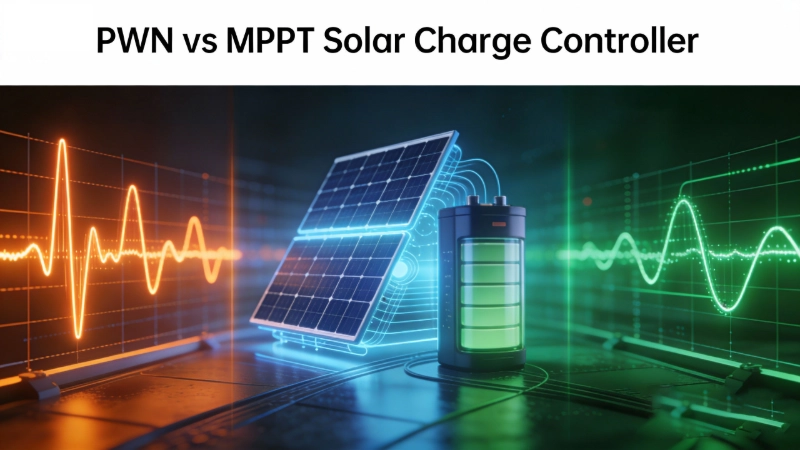
Choosing the right solar charge controller has a direct impact on system efficiency, battery lifespan, and overall return on investment. In this guide, we clearly explain the difference between PWM and MPPT controllers and help you decide which solution fits your solar system in 2025.
New to MPPT technology?
We recommend reading our in-depth guide first:MPPT Technology: Complete Guide to Maximum Power Point Tracking (2025)
What Does a Solar Charge Controller Do?
A solar charge controller regulates the power flow from solar panels to batteries. Its primary role is to prevent overcharging, control charging voltage, and protect batteries from deep discharge. Whether you use PWM or MPPT determines how efficiently your system converts available solar energy into stored power.
PWM Solar Charge Controllers
PWM (Pulse Width Modulation) controllers work by directly connecting the solar panel to the battery and rapidly switching the connection on and off to regulate charging voltage. As a result, panel voltage is pulled down close to battery voltage during charging.
- Lower upfront cost
- Simple, proven design
- Best suited for small systems
- Works well when panel and battery voltages are matched
MPPT Solar Charge Controllers
MPPT (Maximum Power Point Tracking) controllers continuously monitor panel output and adjust operating voltage to extract the maximum possible power. Excess voltage is converted into additional charging current, increasing overall energy harvest.
- 15–40% higher energy yield
- Excellent cold and low-light performance
- Supports higher PV input voltages
- Ideal for lithium battery systems
PWM vs MPPT: Key Differences
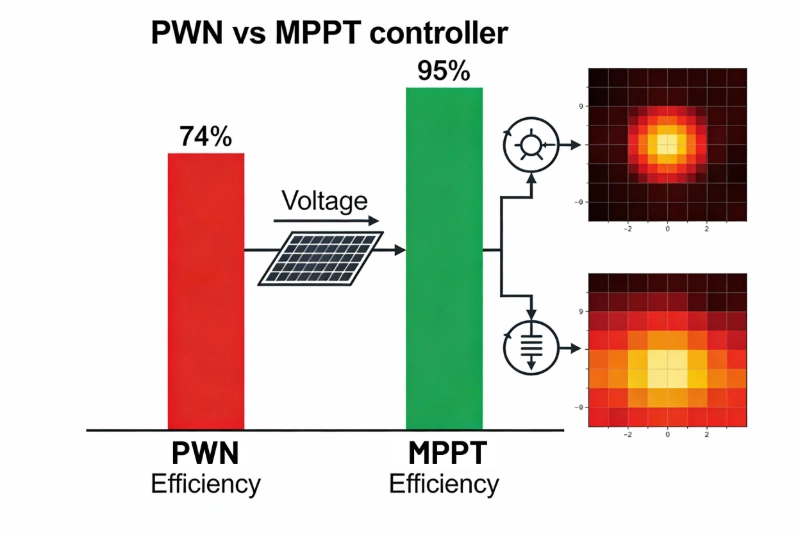
| Feature | PWM | MPPT |
|---|---|---|
| Efficiency | 70–85% | 94–99% |
| PV Voltage Flexibility | Low | High |
| Cold Climate Performance | Limited | Excellent |
| System Size | < 400W | 400W+ |
Real-World Application Scenarios
In practice, the decision between PWM and MPPT depends on system layout, climate, and long-term expansion plans.
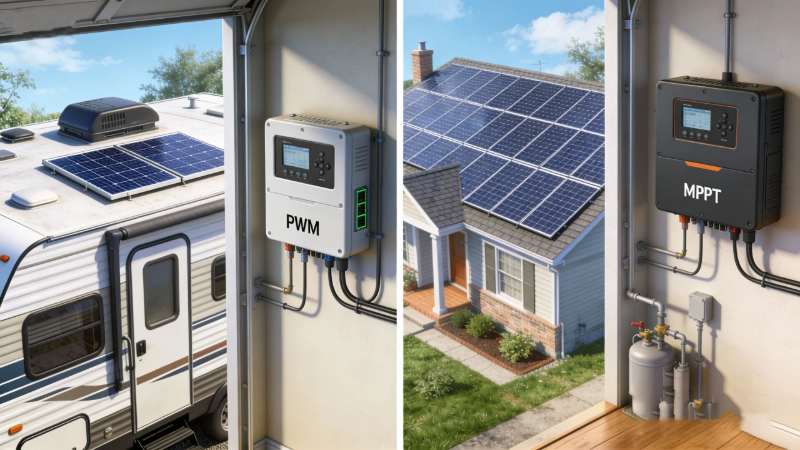
Small Off-Grid Systems: PWM controllers are often sufficient for low-power installations where panel voltage closely matches battery voltage.
Residential & Hybrid Systems: MPPT controllers provide higher efficiency and flexibility, making them the preferred choice for rooftop and battery-backed systems.
Commercial & Energy Storage Systems: MPPT is essential for managing higher power levels and ensuring predictable performance.
Which Solar Charge Controller Should You Choose in 2025?
For most modern solar installations, MPPT controllers offer better long-term value through improved efficiency, design flexibility, and future scalability.
PWM controllers remain a practical option for very small systems where simplicity and cost are the primary concerns.
Need Help Choosing the Right Controller?
Our team can help you select the best PWM or MPPT solution for your system.
Get Expert Advice →